
Filing for a Deployed Spouse or Aging Parent: The Power of Attorney Guide
Part 2 of the Tax Season Survival Series
Tax season can feel overwhelming enough on its own, but what happens when you need to file taxes for someone who isn't physically here? Maybe your spouse is deployed overseas. Maybe your aging parent can no longer manage their own paperwork. Maybe both situations are hitting at once (hello, military families juggling multiple generations).
Here's the good news: a Power of Attorney (POA) can legally authorize you to handle tax returns on someone else's behalf, and as a mobile notary serving Fort Greely, Delta Junction, and Interior Alaska, I've helped plenty of families navigate exactly this scenario.
Let's break down how POAs work for tax filing, what you actually need, and how to get it done without adding more stress to your plate.
What Is a Power of Attorney (And Why Does It Matter for Taxes)?
A Power of Attorney (POA) is a legal document that gives another person, called your "agent" or "attorney-in-fact", the authority to act on your behalf for specific legal or financial matters.
For taxes, that might mean:
Signing and filing federal and state tax returns
Communicating with the IRS or state tax agencies
Accessing financial records needed for preparation
Making decisions about deductions, credits, or amendments
Important distinction: A POA for tax purposes is different from IRS Form 2848 (Power of Attorney and Declaration of Representative), which is specifically for authorizing a tax professional like a CPA or enrolled agent to represent you before the IRS. What we're talking about here is a general or special POA that allows a family member to sign and file your return.
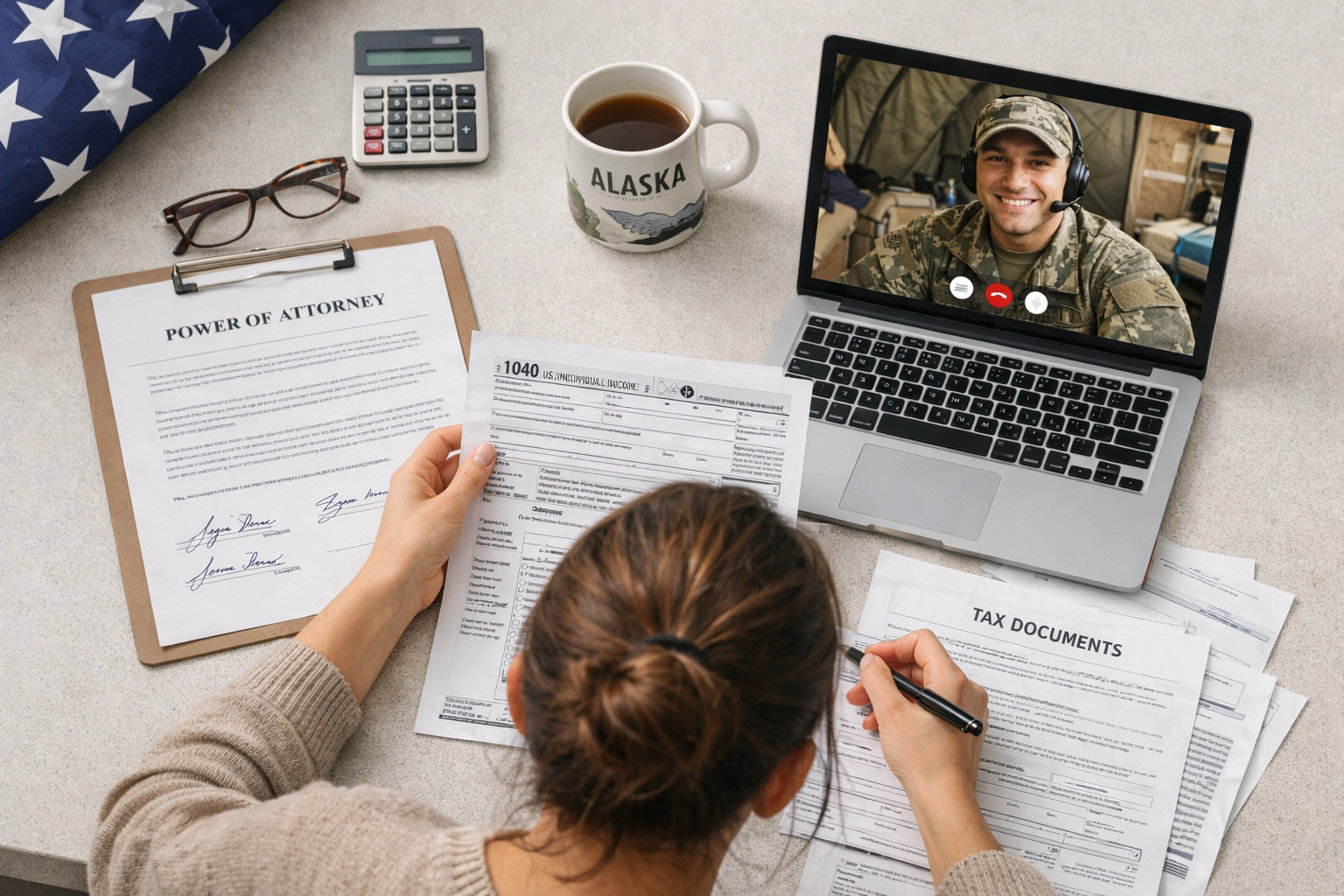
Filing Taxes for a Deployed Spouse: Military POA Basics
If your spouse is deployed, you likely already know that managing finances from opposite sides of the world isn't simple. Tax season just adds another layer.
Do You Actually Need a POA?
Here's the first question: Do you and your spouse file jointly and share joint bank accounts?
If yes, you may not need a POA at all. Joint filers can generally sign for each other on a joint return (though some tax preparers or institutions may still request documentation). If your accounts and property are jointly owned, your spouse likely already has legal access to what's needed.
But if any of the following apply, a POA becomes critical:
You own property or accounts individually (not jointly)
You need to access your spouse's military pay records or benefits
You're handling complex transactions (selling a vehicle, refinancing, etc.)
Your spouse's command requires POA documentation for certain decisions
Types of Military POA
Military families have access to two primary types of power of attorney:
General POA , This gives your agent broad authority to act on your behalf across nearly all legal and financial matters. It's powerful, flexible, and often the go-to for long deployments when you can't predict what might come up.
Special POA (SPOA) , This limits authority to specific tasks you outline in the document. For example, you might authorize your spouse to file taxes, sell a car, and access one particular bank account, but nothing else.
The military offers specialized SPOA forms tailored to deployment situations, including:
SPOA-Banking (basic financial matters)
SPOA-Financial Matters Generally (broader than banking alone)
SPOA-Personal Property (vehicles, mail, property transactions)
For tax purposes specifically, you'll likely want either a General POA or an SPOA-Financial Matters form that explicitly mentions tax filing authority.
Where to Get Military POA Forms
Active-duty service members can access free legal assistance through their branch's Judge Advocate General (JAG) office or Region Legal Service Office (RLSO). They can help you determine which POA type fits your situation and execute the document properly.
Pro tip: If you're at Fort Greely or surrounding areas and need a POA notarized quickly (especially outside regular office hours), that's where mobile notary services come in. More on that in a minute.
Filing Taxes for an Aging Parent: A Different Kind of POA
Now let's talk about the other scenario: your mom or dad needs help with taxes, but they're no longer able to manage the details themselves.
This situation requires a slightly different approach.
Financial POA for Parents
If your parent is still mentally competent but physically unable to handle paperwork (due to mobility issues, vision problems, or simply being overwhelmed), they can grant you a Durable Financial Power of Attorney.
"Durable" means the POA remains in effect even if your parent becomes incapacitated later. This is crucial for long-term planning.
With a financial POA, you can:
Sign and file their tax returns
Communicate with the IRS on their behalf
Access bank statements, investment records, and other documents needed for tax prep
Make estimated tax payments or handle refunds
Important: Your parent must be mentally competent at the time they sign the POA. If they're already experiencing significant cognitive decline, you may need to pursue guardianship or conservatorship through the court system, which is a much more involved process.
Healthcare POA vs. Financial POA
Don't confuse a Healthcare Power of Attorney (which allows you to make medical decisions) with a Financial POA (which covers money matters, including taxes). You might need both, but they're separate documents with separate purposes.

How to Execute a POA Properly (Spoiler: You Need a Notary)
Here's where things get official.
For a Power of Attorney to be legally valid, it generally must be:
Signed by the person granting authority (the "principal")
Witnessed and/or notarized according to your state's laws
In Alaska, most POA documents require notarization. That means the principal must appear before a notary public, present valid identification, and sign the document in the notary's presence.
Military ID Disclaimer: If you're using a military ID as identification, please note that by federal law, a military ID cannot be photocopied for any reason. I can verify your ID in person, but I cannot make a copy for my records.
Mobile Notary: Why It Matters for POA Signings
Let's be real: getting to a notary's office isn't always easy.
Maybe your aging parent has mobility challenges. Maybe you're juggling kids, work, and a deployment. Maybe you're stationed at Fort Greely and the nearest notary office is a drive you don't have time for.
That's the whole point of mobile notary services. I come to you, whether that's your home, your parent's assisted living facility, or even on-base at Fort Greely (with proper access clearance).
For POA signings, mobile notary is especially valuable because:
Your parent doesn't have to travel (huge relief if they're elderly or unwell)
You can schedule after-hours or weekend appointments around your work schedule
We can handle multiple documents in one visit (POA, tax forms, healthcare directives, whatever you need)
You can learn more about mobile notary convenience here.
What Happens After the POA Is Signed?
Once your POA is notarized and legally valid, here's what to do:
1. Keep the original in a safe place. You'll need it if anyone (banks, the IRS, etc.) questions your authority.
2. Provide copies to relevant institutions. Some banks or tax preparers may want a copy on file before they'll work with you.
3. File IRS Form 2848 if needed. If you're working with a tax professional who will represent your spouse or parent before the IRS, they'll need this separate form filed.
4. Double-check your state's requirements. Some states require POAs to be recorded with the county recorder's office, especially if real estate is involved.
A Quick Word on Tax Software and POA
If you're using DIY tax software (TurboTax, H&R Block, etc.), the software won't ask you for POA documentation, it's just asking for data entry. But if the IRS audits the return or questions the signature, you'll need to produce the POA to prove you had legal authority to file.
When in doubt, consult a tax professional (CPA or enrolled agent) who can advise on your specific situation.
Final Thoughts: Plan Ahead (Seriously)
Tax season has a deadline. Deployments don't always come with advance notice. Your parent's health can change quickly.
The best time to get a Power of Attorney in place is before you desperately need it.
If you're in Delta Junction, Fort Greely, or anywhere in Interior Alaska and you need help getting a POA notarized, whether for a deployed spouse, an aging parent, or any other reason, reach out. I'll meet you where you are (literally) and make the process as smooth as possible.
You've got enough on your plate. Let's get this handled.
Disclaimer: I am not an attorney licensed to practice law and may not give legal advice or accept fees for legal advice. This blog post provides general information only. For specific legal or tax advice, please consult a qualified attorney or tax professional.
Stay tuned for Part 3 of the Tax Season Survival series:Tax Season Checklist: Don't Let a Missing Signature Delay Your Refund.
Powered by Marblism
Comments